$ / Per Person
Trekking to Makalu Base Camp Trek is not just a trek in the Himalayas. It is also a religious excursion to the holiness of the ‘Beyul Khembalung’.
According to the Tibetan Buddhist tradition, these Beyul are blessed by Guru Padmasambhava, who called them a hidden land. The climb to Makalu Base Camp, trekking to Khembalung, is not an ordinary adventure; it is a spiritual journey, a test of faith.
The Makalu Base Camp trek may be the most spectacular experience for those seeking a closer connection with nature and spirituality, compared to other trekking trails in Nepal.
Your adventure starts from Kathmandu. First, you arrive and spend a while acclimatising. Thereafter, you fly a scenic flight to Tumlingtar.
After landing, a rough ride takes you to Seeduwa (gateway for Makalu Barun National Park). From here, the tramping officially starts.
The path is a slow climb through picturesque woodland and Sherpa-style villages. You see, for example, Tashi Gaon is the last permanent settlement on the road. On your journey, you get to witness the local hospitality of the natives or the day-to-day life in the Himalayas.
In its initial stages, the Makalu Base Camp Trek leads you into the unknown world of mountain culture. Meanwhile, it reveals sceneries not overrun by massive tourism.
The Makalu Barun National Park, based on a high level of biodiversity, is. It flows through rhododendron, oak, and pine forests. The higher the height, the less the settlement fades. Before very long, you are hiking in pure wilderness for more than a week.
Trekking to Makalu Base Camp involves wilderness and remote trails. Thus, it offers a wilderness experience in Nepal. The trail to Makalu Base Camp crosses the high passes, such as Shipton La (4,050m). Then you pass Kalo Pokhari (Black Lake), an impressive lake. Then the trail descends into the grand Barun Valley.
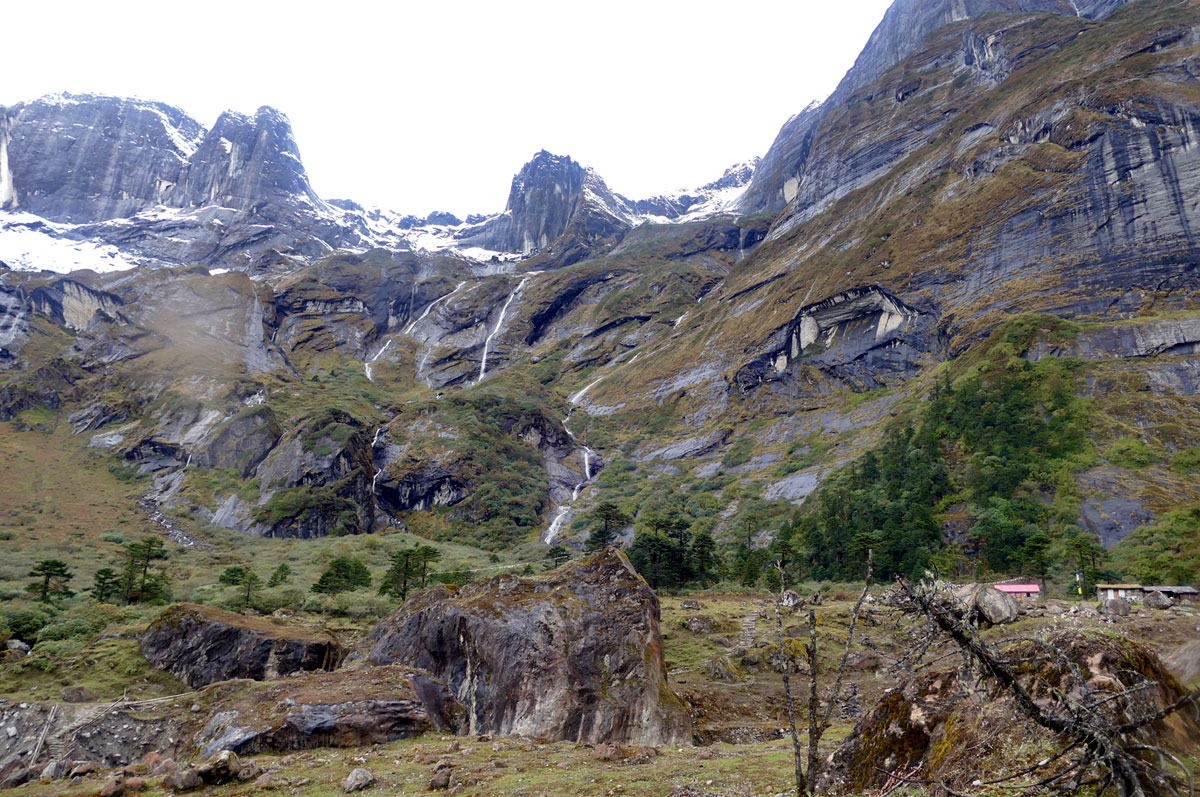
Barun Valley is rich and picturesque, surrounded by high cliffs and snow-capped mountains. Additionally, near Yangle Kharka are the holy caves of Beyul Khembalung. There is a common thought that this sphere is the point of interconnection of the physical and spiritual worlds.
At last, you reach an altitude of Makalu Base Camp at 4,870 metres. The base camp is in a dismal glacial basin at the foot of the giant walls of Makalu, the fifth-highest mountain in the world. This is the place, as well as a physical accomplishment and a spiritual point of climax.
The upper valley brings you slowly through the camps of the yak herders. The higher you go, however, the more rugged by way of alpine nature the landscape is.
The highlight of the trip is arriving at Makalu Base Camp. A dedicated exploration day will take you to hike up to a ridge at 5250 metres. Although the climb is arduous, the reward is extraordinary.
Makalu Base Camp offers panoramic views of the surrounding Himalayan peaks and is among the best ridge views available. You are even able to have a sight of Makalu, Baruntse, and even the Kangshung Face of Everest. Consequently, this day is one of the most memorable days in the trek.
It is one of the most fulfilling high-altitude adventures in Nepal for serious trekkers and adventure lovers.
The same scenic route to the Barun Valley is the wasteland road on the way back. Then round the high passes, one more time, and down to Tumlingtar. At last, you get into a plane to Kathmandu to celebrate your memorable journey.
Now, looking back at the trip, you have many achievements. The Makalu Base Camp Trek is not only a test of physical prowess but also an experience that broadens your outlook on nature, culture, and even spirituality.
For a day-to-day itinerary, hotel information, customised programs, or anything else related to your travel plan. Please get in touch with annatreks@gmail.com or WhatsApp/Message at +977 985 10 30619. You can also message us on Facebook.
A Spiritual Pilgrimage: Journey to the sacred Beyul Khembalung, a hidden valley blessed by Guru Rinpoche, transforming a physical trek into a profound spiritual odyssey.
Ultimate Wilderness & Challenge: Test your limits in one of Nepal’s most remote and demanding trekking regions, leaving human habitation behind for over a week in a true expedition-style adventure.
Awe-Inspiring Panoramas: Witness one of the world’s most spectacular mountain panoramas from a 5,250m ridge, featuring the colossal Kangshung Face of Everest, Makalu, Lhotse, and Baruntse.
Pristine & Diverse Landscapes: Traverse a stunning variety of ecosystems, from lush rhododendron forests and the deep Barun Valley to arid, arctic-like terrain at the base of the world’s fifth-highest mountain.
Traditional welcome and free time to explore the vibrant Thamel district.
Optional guided tour of UNESCO World Heritage Sites or final gear preparation and trek briefing.
Scenic mountain flight to Tumlingtar and a rugged 5-hour jeep ride into the hills.
Trek for ~4 hours. Ascending through forests and farmland to the last permanent Sherpa village on the trail.
Trek for ~6 hours. A challenging climb through rhododendron forests; first stunning panoramic views of Makalu and Kanchenjunga.
Trek for ~6 hours. Traversing high passes (Tutu La, 4,050 m) and passing the striking Kalo Pokhari (Black Lake).
Trek for ~5 hours. A welcome descent into the lush, green Barun Valley—a key acclimatization day.
Visit the sacred pilgrimage caves of Beyul Khembalung, a gateway to a revered hidden valley.
Trek for ~4 hours. Gradual ascent into a rugged, alpine landscape with simple, beautiful campsites.
Trek for ~5 hours. First majestic views of Makalu and trekking past the Barun Glacier to base camp.
View-finding hike to a 5,250 m ridge for a world-class panorama of Everest, Lhotse, and Makalu.
Trek for ~6 hours. Pleasant descent back to the lush, oxygen-rich meadows of the Barun Valley.
Trek for ~6 hours. The challenging re-ascent out of the Barun Valley back to the high forest camp.
Trek for ~4 hours. Crossing the Shipton La pass again for final high-altitude views.
Trek for ~5 hours. Long, beautiful descent through rhododendron forests back to the tree line and Sherpa villages.
Trek/Drive: ~4 hrs trek / ~4 hrs drive. Final hike down the ridge and a jeep ride back to the lowlands of the Arun Valley.
Final scenic flight over the Himalayas and celebration of your completed adventure.
Free day to relax, shop, or take an optional guided city tour (Patan and Bhaktapur)
Transfer to the airport for your international flight home.
The Makalu Base Camp Trek is a true wilderness adventure for trekkers seeking to go beyond the beaten pathwith no communication facilities, long stretches between settlements, and basic teahouses/lodges. The Tea House and lodges are far more rustic than on the Everest or Annapurna circuits. Rooms are simple (often twin-share), and shared toilets are standard. Running Hot showers, except for the bucket shower, is a luxury and not available for the entire trek. Consider camping for a heavenly experience, but be prepared for elevated costs. The trek to Makalu Base Camp rewards breathtaking, untouched landscapes and a profound sense of accomplishment. Prepare thoroughly, respect the altitude, and you will have an unforgettable experience to find your “elsewhere.”
|
Duration |
19 days |
|
Max Elevation |
5,250m (Makalu Base Camp). |
|
Grade |
Strenuous to Challenging (due to high-altitude, remote terrain, steep, sustained ascents and descents). |
|
Best Seasons |
March-June and September-December |
|
Highlights |
Raw Himalayan beauty, a unique blend of Hinduism and Buddhism, offers a socio-cultural experience ranging from the warmest to the coldest temperatures, with a raw and hidden nature. It is a sacred land for pilgrimage, and a serene walk through protected areas. |
|
Route |
Kathmandu → Tumlingtar → Seeduwa → Barun Valley → Makalu Base Camp |
|
Category |
Detail |
|
Who can join these treks |
The trek suits fit, health-conscious travellers aged 15+ who can handle high altitudes and uphill/downhill challenges in extreme weather conditions. There is no upper limit for seniors to join if they are physically fit and medically cleared. First-timers with dedicated commitment and basic to adequate training are welcome. Our experienced guides and support staff (guide helpers, porters, kitchen crew) lead the trek and provide overall care. |
|
Group Policy |
We specialise in premium private treks and tours. We do not combine individual travellers into groups. Your “group” is defined solely by the friends, family, or colleagues you choose to travel with when booking a specific program. This policy guarantees a personalised and exclusive adventure tailored just for you. |
|
Required permits |
-Makalu National Park permit: NPR 3,000 (~23$).
Makalu Rural Municipality Entry Permit: A local area permit |
|
Guide |
Guides are mandatory; as of March 2025, all trekkers must hire a government-licensed trekking/climbing guide. |
|
Physical Preparation |
Involving steep ascents and descents, as well as rocky trails. Remote trails requiring daily walks of 4–7 hours, hikes over rocky terrain and high passes with/without snow/ice. Long-distance running, cycling, or stair climbing for 3-4 hours a week. Focus on legs (squats, lunges), core, and back. Take multi-day backpack hikes (build to 10–15 kg) if you are not using a porter service. Be mentally prepared for basic living conditions, physical discomfort, and the mental challenge of consecutive long and hard days. Set your mind to enjoy the changes in nature. |
|
Safety and Health |
Be mindful of altitude sickness and recognise symptoms (headaches, nausea, dizziness). Take preventative measures (such as taking Diamox or acclimatising rest days), and descend immediately if symptoms become severe. |
|
Vaccinations |
Consult a doctor for recommendations (recommended for typhoid, hepatitis A/B, and tetanus). |
|
Insurance |
Must cover emergency helicopter rescue (up to 5,500 m) and medical service. We strongly advise all trekkers to invest a little more in addition to the trip cost and purchase comprehensive insurance that covers all kinds of emergencies, ensuring you are financially secure and prepared for unforeseen circumstances. |
|
Water and Food |
Avoid tap water; use purification tablets or bottled water. Menus expand at lower elevations (daal bhat, pasta, momo, noodles). Eat carb-rich meals (daal bhat, garlic soup for altitude). Avoid meat (no refrigeration) and salads (due to risks from tap water). Try local chhang-Tongba (barley beer) if they use treated water. |
|
Cash |
The package cost covers major expenses. Since there are no ATMs above Tumlingtar, we recommend carrying some Nepalese Rupees or a convertible currency in cash. Convertible currencies are accepted, but they convert at a lower rate. |
|
Connectivity |
If there is no connection for more than a week, we provide a Satellite Phone for emergency use and messaging. |
|
Tipping |
Tips for guides/porters: please allow $5–$10/day per member. |
The following table outlines seasonal packing priorities, which include all essentials, as well as a clothing layering system for variable conditions.
| Season | Clothing | Key gear |
| Spring/Autumn | thermal base + fleece + heavy down jacket (-15°C) + waterproof shell | -20°C to -25°C sleeping bag, Microspikes (for High Pass). |
| Winter | Heavy thermal base, down jacket/pants (-20°C), balaclava | -30°C sleeping bag, Microspikes |
| Monsoon | Quick-dry clothing, a complete waterproof suit | waterproof pack cover, insect repellent, 15-20° sleeping bag |
| Clothing Layering System for Variable Conditions | ||
|
Layer Type |
Key Items |
Purpose |
|
Base Layer |
Merino wool/synthetic tops and leggings | Moisture-wicking (temperature regulation) |
|
Mid Layer |
Fleece jacket; down vest/jacket | Insulation: retains body heat |
|
Outer Shell |
Waterproof/windproof jacket and pants | Shields against rain, snow, and wind |
|
Accessories |
Warm hat, sun hat, buff, waterproof gloves (inner + outer), wool socks (2–4 pairs) | Protects extremities from cold/frostbite |
|
Foot ware |
Broken-in waterproof hiking boots + Camp shoes. |
|
Essentials |
Sunglasses, trekking poles (for mud/snow), reusable water bottle, headlamp, first-aid kit, portable charger, high-SPF sunscreen, lip balm, toilet paper, and earplugs. |
|
Backpack |
25–30L (Daypack for you). |
|
Duffel Bag |
≤15 kg (for Teahose Trek), ≤30 kg (for Tented Camp Trek). |
|
First-Aid Kit |
Bring personal medications; the agency provides a group first-aid medical box. |
|
Note |
Use packing cubes to organise gear. Limit clothing to 2–3 sets of quick-dry layers. |
Tumlingtar hotels with attached baths (located in the warm, low-lying area) and those from Seedua to Makalu Base Camp are family-run lodges offering basic rooms with blankets and pillows. Most lodges have shared bathrooms/toilets, which are more than the expected standard at higher altitudes. The availability of hot shower facilities depends on altitude; lower valleys such as Tumlingtar offer piped/running hot water, while higher elevations with cooler temperatures offer only bucket-style showers (heated on request).
Dress modestly (covering shoulders/knees in villages) to show respect and consideration for the local culture and customs. Circumvent clockwise around the Mani walls, stupas, and monasteries, or any sacred sites. Ask permission before photographing people, and refrain from photographing children when they are alone or without their guardian’s consent. For eco-friendly practices, carry out non-biodegradable waste (and hand it over to your guide upon arrival at your camp), use biodegradable products, and avoid plastic items (bring a reusable water bottle instead).
Rent/buy a down jacket/sleeping bag in Kathmandu to save space.

I had always thought that trekking in Nepal required a looong time and that it had to be done in either spring or autumn. That was until a friend told me that it was also possible to do it in winter, and that you can reach places like the Everest...
Read More
[gallery columns="1" link="file" size="full" ids="5878"] [gallery size="full" columns="1" ids="5903"]
Read More
In August 2025, my wife and I decided to take the famous Everest Base Camp trek with Annapurna Treks, and we had a wonderful experience thanks to the company's excellent organization. We had never been to Nepal before, but we knew that during the monsoon season there was a high...
Read More