Country name: Nepal
Capital: Kathmandu
Area: 147,181 sq km (56,827 sq miles)
Location: Nepal borders on the Tibet Autonomous Region of the People’s Republic of China in the north and India in the east, south and west.
Major language: Nepali
Major religions: Hinduism, Buddhism
Population: 27 million (with 2.1% growth rate)
Language: Nepali is the national language of Nepal. Educated people understand and speak English as well (there are 63 tribal languages).
Fiscal year: The Nepalese fiscal year starts in mid-July.
Time: Nepal standard time is 5 hours 45 minutes ahead of GMT and 15 minutes ahead of Indian standard time.
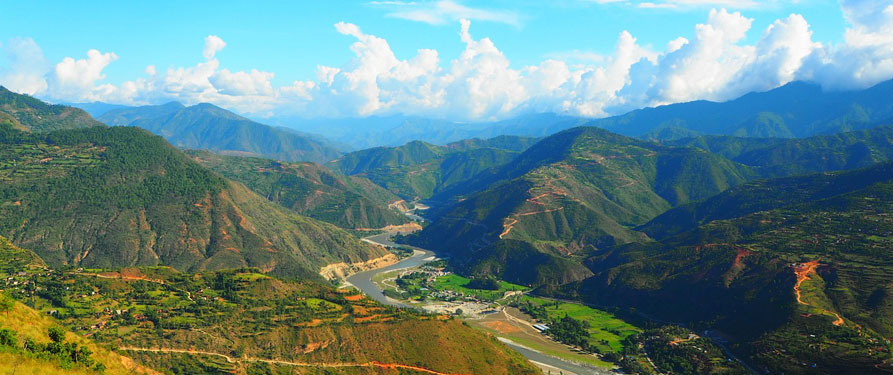
For anyone who loves the mountains, life is no better than a trek through the Nepalese Himalayas. The highest mountain range in the World defines everything about Nepal, from its topography and weather to its religion and trade. It’s also home to the grandest mountain scenery you’ll ever see. ‘In a hundred ages of the gods,’ rhapsodises the ancient Indian text the Skanda Puran, ‘I could not tell thee of the glories of Himalaya’.
Nepal is not just a destination for seasoned trekkers, but also for those seeking a hassle-free adventure and amateur trekkers. It sets the global standard for spectacular, nature-connected, hassle-free trekking, especially in the teahouse trekking regions of Everest, the Annapurnas, Langtang, Peekye, Poon Hill, Makalu Base Camp, Kanchenjung Base Camp, and the Surrounding Areas. Nowhere else can you hike for weeks into the heart of a mountain range, safe in the knowledge that at the end of the day, you can count on a clean bed, a hot meal and a slice of warm apple pie! That means that trekking trails are at their most accessible, allowing you to leave the tent, stove and freeze-dried goulash at home and focus on the breathtaking scenery and unique experiences.
However, Nepal’s allure doesn’t end only with the famous tea house trek. Its mountains are both a sight to behold and a gateway to unique experiences. The superb trek staff, including porters, Sherpas, cooks, and trekking agencies, can take you off the beaten path to high–altitude camps at the bases of 8,000m peaks or over 5,000m passes into remote and timeless pockets of Tibetan culture. The local culture and customs of Nepal’s diverse peoples, along with their unwavering good humour, are as big a draw as the peaks, offering a truly unique and varied experience.
As the saying goes, one trip to Nepal is rarely enough. If you’ve already experienced the majesty of Everest or the Annapurnas, consider a trek through Langtang or around Manaslu. And once you’ve conquered those, venture out to the remote Dolpo or Kanchenjunga at the far ends of the country. With such diverse trekking options, it’s hard to think of a better way to spend a couple of weeks of your life.
From ancient to modern day, the history of Nepal is a profound narrative of ancient civilisations, the birthplace of spiritual luminaries, and the remarkable synthesis of Hindu and Buddhist traditions. Situated in the majestic Himalayas, its story spans from prehistoric settlements to its current identity as a vibrant, modern nation.
Long before recorded history, people already inhabited the land that would become Nepal. Archaeological evidence, including Palaeolithic, Mesolithic, and Neolithic tools discovered in the Siwalik Hills, suggests that early human activity occurred in this region. Scholars believe that the earliest inhabitants had connections to the Indus Valley Civilisation (3300–1200 BCE), with possible pre-Dravidian and Dravidian roots.
By 4000 BCE, Tibeto-Burmese peoples began arriving, likely from Tibet and via Myanmar. These early groups laid the groundwork for Nepal’s multi-ethnic character. Ancient texts recount legendary accounts of the Gopālavaṃśi (Gopal Bansa), also known as the “cowherd dynasty,” as the earliest rulers, with the Kiratas later succeeding them. The Kirata rule is said to have lasted for an astonishing 16 centuries, establishing a significant era in Nepal’s legendary history.
The Kathmandu Valley, the cultural and political heart of Nepal for millennia, has its own creation myth. Geological evidence suggests the valley was once a vast lake. According to Buddhist tradition, the Bodhisattva Manjushree (“Beautiful One with Glory”) came from the north and, with a single stroke of his sword, cut through the rim of the Chobar gorge, draining the waters and making the land habitable. This fertile valley, which he named after the sage Ne, became known as Nepal.
The valley’s indigenous people, the Newars, developed a unique and sophisticated urban culture. Their distinctive architectural style, particularly the multi-tiered pagoda temple, came to define the valley’s city-states of Kathmandu, Patan (Lalitpur), and Bhaktapur.
The recorded history of the Kathmandu Valley becomes clearer with the rise of the Licchavi dynasty around 400 CE. Originally from Vaishali in India, the Licchavis overthrew the Kiratas and established a kingdom known for its art, architecture, and inscriptions. King Mana Deva I, one of its greatest rulers, is credited with introducing the pagoda roof and building magnificent temples. This period saw Nepal become a vital intellectual and commercial hub linking South and Central Asia.
The Malla dynasty followed the Licchavi period and ruled from the 13th to the 18th century. The Mallas, particularly King Jayasthiti Malla (1382-1395), introduced a job-based caste system deeply influenced by the Brahmanical uprise in India. After the division of the kingdom, the three rival city-states of Kathmandu, Patan, and Bhaktapur actively competed culturally and economically, further enriching the valley’s architectural and artistic heritage.
Nepal is revered as a sacred land, having given birth to several Buddhas.
Ancient Buddhas of the Bhadrakalpa: According to Theravada Buddhist tradition, the present auspicious age (bhadrakalpa) will see five Buddhas. The first two were born in what is now Nepal. Kakusandha Buddha, the first Buddha of this era, was born in Khemavati, identified with modern-day Gotihawa in southern Nepal. The second, Koṇāgamana Buddha, also achieved enlightenment in the Nepalese plains.
The 29th Buddha (in the Theravada Tradition)/Sixth Buddha (in the Mahayana Tradition), Gautama Buddha (Siddhartha Gautama, 563–483 BCE), the most renowned, was born in Lumbini, southern Nepal. As the son of a Shakya clan king, he renounced his royal life, attained enlightenment, and founded Middle Path Buddhism. His teachings spread from his homeland across Asia and the world, making Lumbini one of the most important pilgrimage sites for humanity.
A defining feature of Nepalese culture is the profound and peaceful synthesis of Hinduism and Buddhism. This syncretism is evident everywhere:
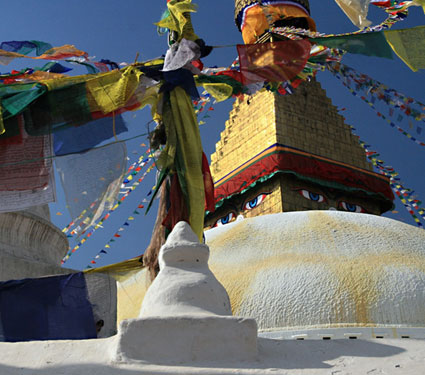
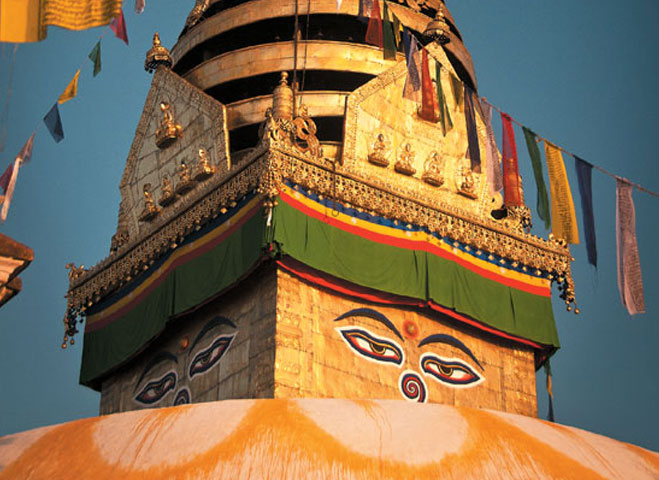
Shared Sacred Sites: Both Hindus and Buddhists venerate temples and stupas. The Swayambhu Stupa, Changunarayan and Buddha Nilkantha, for instance, are primary Buddhist sites also revered by Hindus.
Intertwined Legends: The legend of Manjushree, the protecting deity of Kathmandu Valley, a central figure in Mahayana Buddhism, is part of the origin story for all Nepalese, regardless of religion.
Architectural and Festive Fusion: The Malla kings, once guardians of Buddhist and later devout Hindus, patronised both religions, building stupas and temples that stood side-by-side. Festivals often incorporate elements from both traditions, a “remarkable synthesis” that is a hallmark of Nepali life.
Doctrinal Adoption: Over centuries, Hindu rulers and practitioners in Nepal incorporated key Buddhist values, such as non-violence (ahimsa) and compassion, into the fabric of mainstream Hindu society. This integration has allowed Hinduism and Buddhism to thrive respectively in a majority-Hindu nation, creating a unique religious landscape in which the two faiths are deeply interdependent.
From its mythical origins to its modern republican identity, Nepal’s history is a testament to its role as a cradle of spirituality and a meeting point of diverse cultures. Its legacy as the birthplace of several Buddhas and a land where two great religions harmoniously coexist continues to define its unique character on the world stage.
The modern nation of Nepal was forged through unification by Prithvi Narayan Shah, the king of the small principality of Gorkha. In the mid-18th century, Prithvi Narayan Shah embarked on a war campaign of conquest in the neighbouring region, achieving significant victories. He invaded the Kathmandu Valley in 1768, overcoming the divided Malla kingdoms and moving his capital to Kathmandu. This achievement established the larger Kingdom of Nepal and the Shah dynasty, which would rule for 240 years.
The following years were marked by wars with the British East India Company, culminating in the Treaty of Sugauli, signed on 4 March 1816, which ended the Anglo-Nepalese War (1814–1816). As a result of the Treaty of Sugauli, Nepal ceded a significant portion of its territory to the British East India Company.
The major territories lost by Nepal and incorporated into British India were the Western, southern, and eastern reaches of the country. The ceded western territories are the Kumaon Kingdom (the entire region of Kumaon), Garhwal Kingdom (the bulk of the Garhwal region), the Doab of the Sutlej and Yamuna (the fertile lands between these two rivers); these days, the divisions of Garhwal and Kumaon form the entire Uttarakhand state of India, along with some adjoining areas in Himachal Pradesh.
The ceded Southern Territories, the Terai Region, are large tracts of land stretching from the Kali River in the west to the Koshi River in the east. These ceded Tarai lands are now part of the Indian states of Uttar Pradesh, Bihar, and West Bengal. The loss of the southern Terai was a significant economic blow, as the region was highly fertile and productive.
Eastern Territories ceded by the Treaty are the territories of Sikkim, which Nepal previously captured from the Kingdom of Sikkim. The loss of Nepal restored Sikkim’s sovereignty, but it later became a British protectorate. The Darjeeling Region, which would later become the “hill station of Darjeeling”, was also part of this cession. The returned territories now form the state of Sikkim and the Darjeeling district of West Bengal, India.
Due to Nepal’s forced diplomacy and the British desire to have a stable, cooperative buffer state, the British returned some of the ceded Tarai lands to Nepal. By that time, known as the “Naya Muluk” (New Country), it lay between the Kali River in the west and the Rapti River in the east, comprising the districts of Banke, Bardia, Kailali, and Kanchanpur.
Internal power struggles led to the rise of the Rana family, who reduced the Shah kings to figureheads and ruled as hereditary prime ministers from 1846 to 1951. A democratic revolution in 1951 restored royal power, but political instability persisted. In a historic vote, the people abolished the monarchy in 2006, and on 28 May 2008, they declared Nepal a Federal Democratic Republic, formally ending monarchical rule.
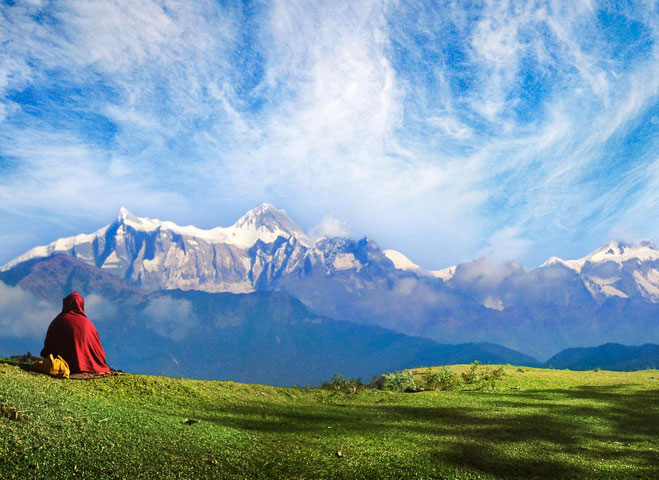
For anyone who loves the mountains, life is no better than a trek through the Nepalese Himalayas. The highest mountain range in the World defines everything about Nepal, from its topography and weather to its religion and trade. It’s also home to the grandest mountain scenery you’ll ever see. ‘In a hundred ages of the gods,’ rhapsodises the ancient Indian text the Skanda Puran, ‘I could not tell thee of the glories of Himachel’.